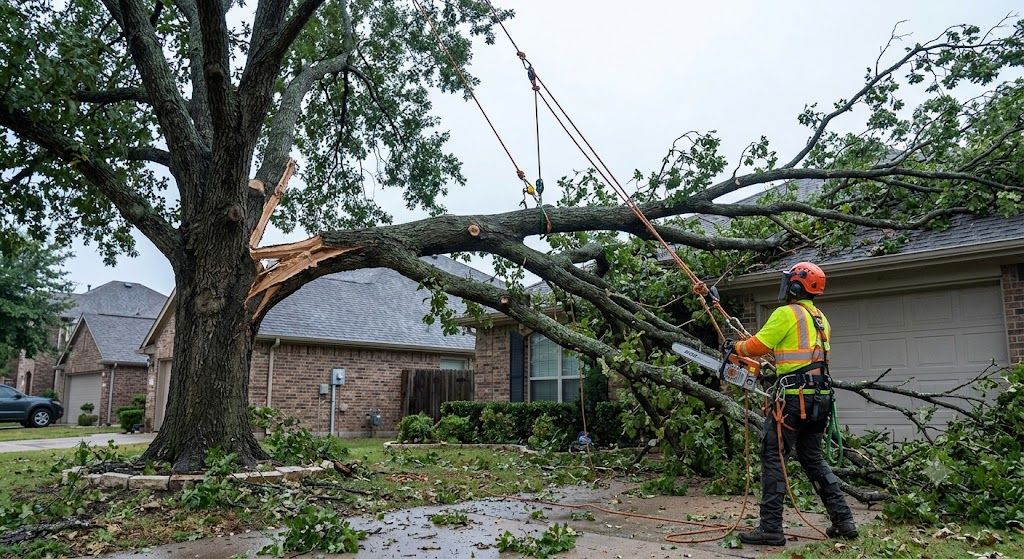
Most trees give warning signs long before they fail. Knowing what those signs look like can save you from a limb through the roof or a tree across the driveway after the next Santa Ana wind event. Here are seven things to check.
1. Large dead branches
Dead limbs over the house, the driveway, or places people walk are the most common hazard we see. A few dead branches can be handled with tree trimming. When a large share of the canopy is dead, the tree is usually in serious decline and removal is the safer call.
2. A new or worsening lean
A tree that has leaned the same way for decades has often adapted to it. A lean that shows up suddenly, especially with cracked or heaving soil on the opposite side of the trunk, can mean the roots are failing. That's an urgent situation.
3. Cracks, cavities, and missing bark
Deep vertical cracks, hollow sections, and patches of dead or missing bark point to internal decay. A cavity doesn't automatically mean removal, but a large one in the main trunk weakens the whole tree.
4. Mushrooms or decay at the base
Fungal growth at the base or on the root flare is often a sign of root or butt rot. Root decay is dangerous because the tree can look fine up top until it falls.
5. Tiny beetle holes and staining
Invasive shot hole borers have damaged trees across Southern California, including sycamores, oaks, and many landscape trees. Look for tiny round holes about the size of a ballpoint pen tip, often with wet staining, sugary gumming, or fine sawdust around them. Heavily infested trees tend to drop branches and may need to come down.
6. Weak forks with two main trunks
Trees with two competing trunks that meet in a tight V often have bark trapped in the joint. These unions can split apart in wind, taking half the tree with them.
7. The tree is simply in the wrong place
A healthy tree can still be a problem if its roots are lifting a foundation or getting into sewer lines, or if it's too close to a house in a fire zone. In those cases removal is a practical decision, not an emergency.
What to do next
If you see any of these signs, get the tree looked at before the next windstorm. If it does come down, plan on stump grinding too, especially for species that sprout from their roots. Inside the City of Los Angeles, check whether your tree is a protected native species first. Our tree permit guide explains the rules.
Call (877) 552-8556 to get connected with a local crew, or find your city on our service areas page.
Need a tree taken care of in Los Angeles County?
Call now to get connected with a licensed, insured local crew for a free quote.
(877) 552-8556Keep reading
- The Los Angeles Homeowner's Guide to Tree Trimming
- Stump Grinding vs. Stump Removal: Which Do You Need?
- Do You Need a Permit to Remove a Tree in Los Angeles?
- Fire Season Tree Maintenance for Los Angeles Homeowners
Back to LA Tree Removal Pros home.